.svg)
Table of Contents
You are already sending emails. You are posting online. You are launching campaigns. Yet, your customers don't always respond and your mobile conversion rate is plateauing. Integrating SMS into your omnichannel strategy changes the dynamic, because SMS marketing lands directly on the phone. A recent benchmark highlights a figure that speaks for itself: around a 95% open rate and very fast reading times for the vast majority of messages.
This is precisely why a platform like Octopush fits into an omnichannel strategy : SMS routing, bulk sending, personalization, API, tracking—SMS becomes a true channel that you can manage, not just a one-off effort.
Why use SMS for marketing?
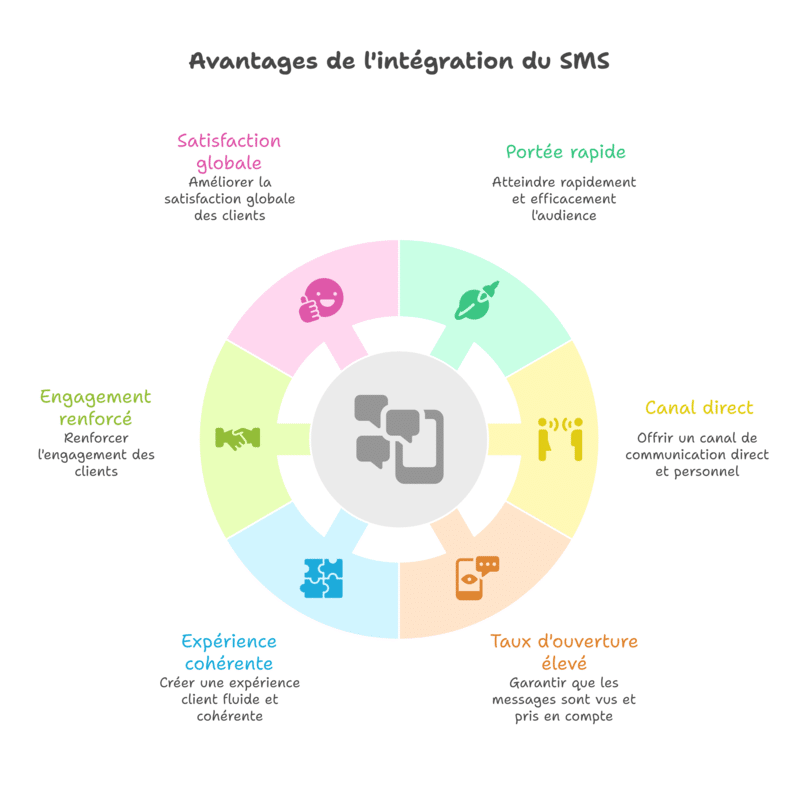
SMS has three simple strengths.
1) It triggers action.
An email informs. An SMS drives action. When you need to get a contact moving quickly (short-term offer, reminder, confirmation), mobile marketing takes the lead.
2) It integrates.
You can integrate SMS into a sequence: email → SMS → web page → purchase. You create a journey that respects the customer's time , without overwhelming them.
3) It strengthens the brand.
A short , consistent, and regular message improves recall. Your brand stays present without becoming intrusive (it’s all about frequency, which we’ll get to).
Quick tip: save SMS for what it does better than other channels. Urgency, clarity, action.
What is the average open rate for an SMS?
According to most industry sources, SMS boasts a very high open rate, often cited between 95% and 98%, with the majority of recipients reading it within the first few minutes.
This number doesn't mean "automatic conversion." It means "message seen." From there, everything depends on your offer, your timing, and your landing page.
Pro tip: measure the real KPI. Not just the open rate. Track clicks, cart additions, purchases, appointment bookings, and calls.
How do you integrate SMS into a customer journey?
Omnichannel isn't about "being everywhere." It's about connecting the dots. SMS becomes the bridge between intention and action.
Scenario 1: Clean welcome
- Welcome email with content, benefits, and social proof
- SMS 24 hours later to guide them toward the main action (account, offer, catalog)
Goal: convert a new subscriber into a first-time buyer without waiting for them to "come back on their own."
Scenario 2: Abandoned cart
- Email 1: reminder + reassurance
- SMS: short follow-up if no action is taken
- Email 2: social proof or a limited-time offer if needed
You can automate this scenario with simple logic: "if no click," "if no purchase." These aremarketing automation scenarios using SMS that save time and stabilize sales.
Scenario 3: Smart loyalty
- Monthly email: content + new arrivals + tips
- Occasional SMS: VIP offer, birthday, limited stock
Benefits of SMS in a loyalty strategy: you avoid radio silence, keep the relationship alive, and reward without spamming.
A quick tip: associate each SMS with a single intent. One action. One page. One promise.
What is the value of an omnichannel strategy?

In multichannel, you use several channels. In omnichannel, you connect everything into a continuous experience, often managed from an omnichannel platform that centralizes messages, data, and workflows.
The customer can start with an email, continue on mobile, and finish on the web. If they receive inconsistent messages, they hesitate. If they experience a seamless journey, they move forward.
And there is a strong signal: the volume of "push" SMS sent continues to rise. The 2025 AF2M barometer reports 15.26 billion push SMS in 2025, an increase compared to 2024.
In other words: the channel remains massively used because it remains effective… when it is well-managed.
How do you combine email and SMS?
Combining means assigning roles.
- Email : content, education, storytelling, proof, product details
- SMS : reminders, activation, timing, immediate action
- Web : conversion, payment, reassurance
Your communication becomes a SMS communication and email coordinated, not two isolated messages.
Pro tip: create a marketing pressure rule. For example: 2 emails per week maximum, 2 SMS per month maximum (adjust according to your business). You protect the experience. You protect deliverability.
Quick tip: segment. An SMS should never be sent to "everyone." It should be sent to a segment: new subscribers, active customers, inactive customers, cart abandoners, VIPs.
What is the difference between multichannel and omnichannel?
Multichannel = multiple channels, often managed separately. Omnichannel = all channels connected in a consistent journey.
SMS integrates better into omnichannel because it accompanies micro-moments: "I'm looking," "I'm hesitating," "I'm buying," "I'm waiting."
When should you send marketing SMS?
Timing accounts for half the results. You must respect your audience and avoid intrusive times. Many guides emphasize choosing "receptive" hours and the importance of not disturbing people too early or too late.
Real-world translation: test two time slots, measure, and keep the best one.
- Flash offer: late morning or late afternoon (often effective)
- Appointment/pickup reminder: morning
- Loyalty: midweek, outside of extreme hours
Pro tip: avoid "standard" on-the-hour times (9:00 AM, 6:00 PM). A slightly offset time can improve visibility.
Quick tip: state the useful information first. The beginning of the SMS must carry the value: offer, reminder, benefit, date.
Octopush: making SMS manageable, not manual
An omnichannel strategy relies on the ability to send, measure, and correct. Octopush highlights sending via platform and via API, with possible integrations and an automation-first approach.
In practical terms, you can:
- create campaigns SMS
- personalize messages
- track delivery and performance
- connect your CRM / e-commerce to trigger sends
(And just like that, everything becomes simpler: fewer files, fewer oversights, more control.)